The Fine Line Between Debt and Strategy
- Forward Thinking

- Dec 2, 2019
- 5 min read
A few weeks ago, I decided to read and write about the effects of growing debt and low interest (In Ray Dalio's post) on investing, wealth inequality, and the labor market; I also decided to analyze the effect on corporate debt (Which does not seem to be terribly concerning as of yet). Then, recently, I watched a video about how Toys 'R' Us went bankrupt because the company focused less on strategy and more on staying alive (Find the video here). Going back to the root of this blog, I then decided to then merge the two concepts and understand how debt affects strategy.
I also think this is an interesting subject because the correlation is not discussed significantly in business school. Having reflected on my business education, I learned about finance and I learned about strategy. However, I never learned about merging the two areas and seeing the interaction between them. So here I am writing about it.
So it seems that debt interacts with strategy in two ways:
There needs to be a fine balance between debt and strategy, internally, to allow for proper capital structure demands / situations and the future growth of the company.
Debt can be either assist a company against the competition or it can be the downfall of a company used by the competition.
I will go into detail below.
There needs to be a fine balance between debt and strategy, internally, to allow for proper capital structure demands / situations and the future growth of the company.
To give some background, the economy, for about the past 10 years, has been doing relatively strong. Since 2010, it has experienced an average annual growth rate of 2.242%. Part of the growth has been fueled by low interest rates set by the Federal Reserve; in October 2019 alone the central bank cut rates to 1.5 - 1.75%.
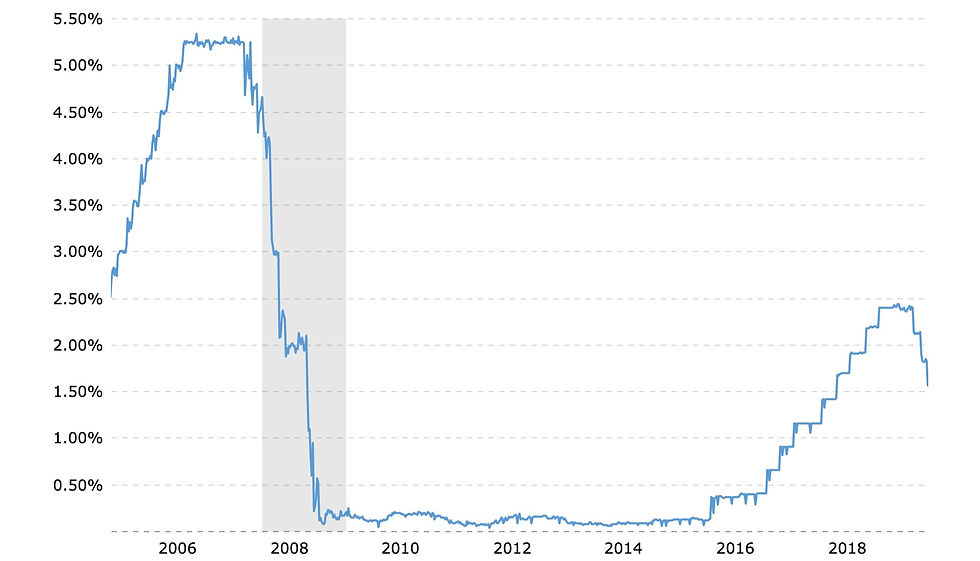
The low interest rates incentivizes companies to take on debt to fund investments because of the low cost of capital; the spur in spending creates more demand and then requires more supply (Basically a repeating cycle). But the cheap cost of capital has incentivized companies to lever up and take on a bunch of debt (An "acceptable" debt-to-equity ratio is considered to be around 1 - 1.5.)

So during the time of economic expansion mentioned above, companies focused more on the "right" strategies to create value and bolster their competitive advantage. That means that they understood their future revenues and invested accordingly as operating managers were concerned about sales, marketing, and production during the period. To do this, companies changed their capital structure by taking on more debt. It is not only fine but also necessary at times to use debt to finance investment in a company's value creating strategy and the future.
Carrying some debt increases a company’s intrinsic value because debt imposes discipline; a company must make regular interest and principal payments, so it is less likely to pursue frivolous investments or acquisitions that don’t create value. - McKinsey & Co.
At the same time of economic growth and increasing debt-fueled investment in strategy, CFOs are aware of the negatives of over-leveraging because of the potential for economic downturns and debt obligations coupled with interest rate hikes. Both situations can bring the realities of either liquidity constraints or violations of debt covenants or both to life. Thus, CFOs want to manage the debt-financed growth properly, without hindering strategy, because being in financial distress can bring a CFO and a company lost opportunities, suboptimal operating policies, or, maybe even worse, inability to access debt capital.
Within the realm of strategy and capital structure, as a result, it is important they work hand-in-hand. During periods of economic growth and value-creating investment in strategy, operating managers must deploy debt capital properly to grow and CFOs must support them, with the proper constraints. At the same time, especially as an economic downturn or an interest hike is on the horizon, CFOs must worry about the future finances of the company (Such as access to debt capital or even preventing bankruptcy) and operating managers must 1) be even more thoughtful about investment in strategy and 2) prepare the different functions of the company for more stringent operating periods without giving up on the company's strategy.
Debt can be either assist a company against the competition or it can be the downfall of a company used by the competition.
During periods of economic growth, companies can use cash from debt (Which I understand is traditionally a liability on the balance sheet) as a "strategic asset" against the competition.
A very clear area, for instance, is Mergers and Acquisitions (M&A). M&A deals, if executed properly and granted that only half do, can create great amounts of value, either through profitability, revenue, and shareholder value, relative to the competition.
M&A can create growth and value...Companies that make multiple acquisitions are far more likely to get it right. [Corporate leaders] pursue M&A, and growth tops the list [through product diversification, market share expansion, and geographic diversification.] Chance favors the well-prepared acquirer. More than 35 percent of all acquisitions result from a window of opportunity created when a specific target becomes available. Another third stems from a disciplined make-or-buy decision. - Boston Consulting Group
During the period of economic growth in the past 10 years, for instance, the value of M&A deals increased significantly from either an increased quantity of transactions or an increased value per a transaction or both. The increase in value of M&A deals, was possible, because of easy access to capital caused by low interest rates. This is evident by the increased use of cash to finance deals rather than equity.

During periods of economic downtown or rising interest rates, however, too much debt has the ability to put pressure on companies and create opportunity for competition. Financial distress, that is caused by refinancing or inability to pay down debt obligations, reduces flexibility and creates constraints for the company, thus making the company unable to react to the competition.
A simple example is that competitors with a specialized product have the ability to aggressively advertise or price to steal sales and increase market share; the financially distressed company may not have ability to react because they do not have the ability to invest in marketing campaigns or cut prices without affecting cash flow and then the ability pay off debt.
Another instance could be that the financially distressed company misses out on M&A opportunities while the competitors are able to take advantage of them and create synergies.
As a result, firms must balance the opportunities of debt and the challenges of debt in relation to the competition and their ability to pay off debt obligations.
As always, it's then time to think about the "so what?"
Companies with stable and predictable cash flows as well as limited investment opportunities should use more debt because of the discipline. Companies that face high uncertainty should use less debt to be flexible and take advantage of investment opportunities or to deal with negative situations.
Build financial reserves (Pay down debt obligations, raise cash, etc.) when times are good.
CFOs need to broaden their range of financing alternatives, but they must must understand that extremely important strategies require established sources of capital that are reliable even in difficult times.
Sources:


Comments