The Dance Between Covid-19 and Utilities
- Forward Thinking

- Apr 26, 2020
- 4 min read
Currently, quite obviously, the international community is facing a threat not seen since the Spanish Flu: Covid-19. This virus, originally touted as not a threat, has become a pandemic; it has caused hundreds of thousands to become ill and has caused thousands of deaths globally, and it does not look like it will be ending anytime soon. In addition, the virus has disrupted global economies, trade, logistics, and daily life: Goldman Sachs predicts the US economy will contract by 24% in Q2 2020. One area that many do not think about, which I do as part of my career, is how will Covid-19 affect the utilities industry (Which is an essential business) and what should utilities do? And those are what I intend to analyze in this post.
One of the most immediate affects of the virus is both a decrease in electricity demand and a change in the electricity customer mix. In the US, stay-at-home orders are shifting a majority of the usage from commercial and industrial to residential; this will lead to drastic reductions in both demand and sales for utilities. With a sharp increase in residential demand, as a result, utilities may ask regulators for a rate increase to mitigate the lost revenue. Or, on the other hand, regulators may have the utilities' ROEs reduced to assist a financially struggled public. Nonetheless, the change in electricity demand mix and the decrease in electricity demand are putting utilities into unprecedented situations.

In the short-term, even with decreased revenues and bad debt expenses recorded on the utilities' income statements, it it key that utilities do not disconnect customers. Much of the American public, even with the stimulus package passed by Congress and President Trump, are financially struggling to make ends meet. As a result, even if customers cannot pay bills at the moment, it is key that public utilities do not 1) tarnish their reputation and 2) get a heavy hand from regulators for disconnecting customers. To also assist with public image and being in the good graces of regulators, utilities can also donate PPE to healthcare institutions to assist with battling Covid-19.
But for the more medium and long term, considering the issues that Covid-19 has created, it is important that, moving forward, utilities respond accordingly and in conjunction with their human capital function through a clear, consistent, and unifying plan from management. And this is what is discussed below:
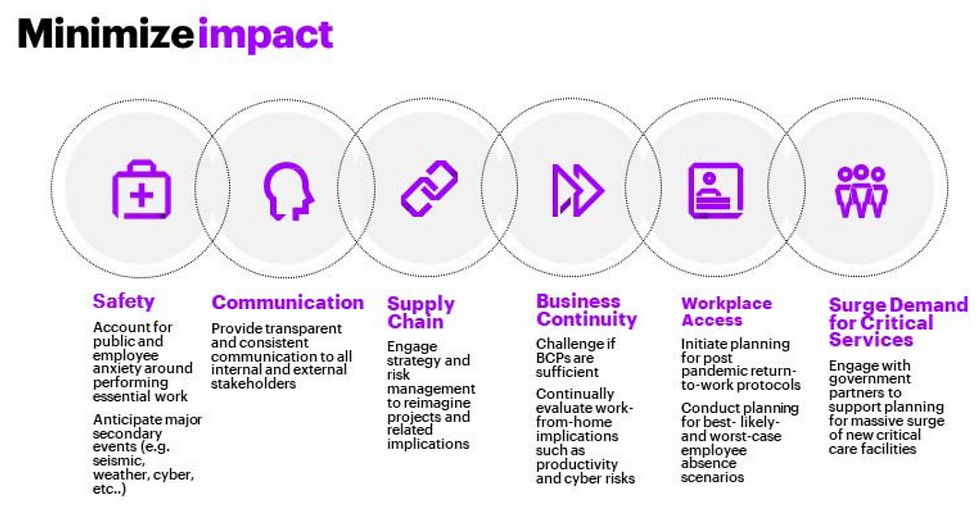
To begin, Covid-19 is another emergency situation, which utilities are used to 1) being prepared for and 2) fighting (In a general sense). This can range from pandemics to natural disasters to cyber security attacks. When a crisis arises, utilities must switch gear into crisis management mode and respond effectively. And in the instance of Covid-19, this can be done through coordinating workforce management and preparedness with other public services and regulatory agencies. Working in mutual assistance with other utilities or public services, through providing a healthy and safe environment for workforces, is key to providing essential services and dealing with critical issues.
Covid-19 does pose the challenge of managing a workforce that is both remote and non-remote (As critical operations must still be done in person). For those who are non-remote and critical, utilities should put risk mitigation programs in place to prevent the spread of the virus, have flexible work arrangements, and increase automation to reduce the need for having employees on-site in the first place. The key is to maintain good health both for employees and their respective communities. On the other hand, for remote employees, it is important to buff up cyber security efforts and trainings and strengthen and enforce remote access management policies.
Another area that the virus threatens is the supply chain of utilities. Utilities must maintain excess supplies and a strong supply chain to replenish broken components or equipment and thus stay in operation. However, the virus is a threat to that supply chain as it will make it difficult for 1) suppliers to produce components and equipment and 2) deliveries to arrive in a timely manner. As a result, it is key that utilities establish a dynamic supply chain to deal with potential inventory issues (As much as they can during a global health crisis) and that they determine critical components and procure those. This may mean having contingency plans for different suppliers and working with other utilities to ensure every utility is still able to operate and produce.
The virus also has the ability to impact financial reporting to regulators, such as FERC and respective states, due to the disruption in the workforce. For reporting purposes, utilities should add and modify current and future judgements and estimates and risk disclosures in their documentation. Also, as changes occur in operations, it is key to think about liquidity and capital resources moving forward to stay solvent. Last, as the customer mix changes, it is key that utilities rebalance their portfolios and partner with other industries to find new opportunities for revenue generation.
A last area to consider is the tax implications. As supply chain issues and workforce mobility issues arise and continue, it is important to think about how Covid-19 will affect the construction of both solar and wind farms, which get sizable tax benefits (Read about solar tax credits here).
So, what's the so what?
In the short-term, from an external perspective, utilities must deal with the blow to revenue generating sources. On the other hand, from an internal perspective, utilities must keep their employees healthy and safe and procure necessary components and equipment to quite literally keep the lights on.
In the long run, utilities must learn from weaknesses that were uncovered from Covid-19, ranging from workforce management to technology management to supply chain management. From learning, they should collaborate together and better prepare for future resiliency. In addition, finding other potential partnerships and revenue generation sources may significantly assist with future solvency.
Here's a video on the effects of Covid-19:


Comments